With several
hundred kits
sold, it seemed like time to add a space (NOT a blog, I swear)
for passing along random notes that might prove useful or
interesting, or both. New stuff generally toward the bottom;
note that some links may have expired. Feel free to e-mail
your own comments and ideas. The
weakest link: Rubber bands. Like people, they will relax over time
if you leave 'em stretched out... so it's a good idea to unhook
them if your Digi-Comp is going "off line" for awhile.
A simple DIY tip for replacement: the Size 10s we use are
uncommon, but go get some longer ones of the same width (1/8 inch,
1.5 mm). Take a band, tie a knot in the middle, and snip off one
side—leaving a small loop with a knot. Speaking of rubber bands: If
your input rods aren't snapping into place like they used to,
and you're up for a few minutes of additional cutting and
gluing, here's a PDF construction
tip to boost the tension of tired (or slightly
oversized) rubber bands.
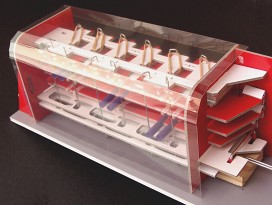 DC gathering dust? Ours was, literally.
Looked so durn purty,
we just left it out on the table, and dust happens. So we
recently
made a dust cover out of a sheet of overhead
transparency (mylar) film. If you happen to have a sheet, try
it. Make a sharp right-angle crease
along one edge, then tuck that edge under the uprights at the
rear (snip away one corner of the film if necessary so it fits
in). Then make several parallel creases close together so the cover
conforms to the beveled corner. Finally, another sharp crease to
lock it precisely over the front edge, and trim off the rest.
Unfortunately, a standard 11-inch
sheet doesn't extend all the way around. To extend coverage to
the front, use legal size (14-inch) transparency film, or, less
elegantly, tape a second sheet to the first. Either way, it will
keep the dust at bay.
Problems, problems: If
you've zipped through the v2.0 manual and are seeking even more
experiments and challenges, check out More Fun for Digi-Comp
I by Bill Kustes (revised edition, June 2008). With nearly 50 new activities including
games, magic tricks, puzzles and the like, it's reasonably
priced at $21 in book or CD form ($35 for both; the CD features
color clip art) plus $4 US shipping. Contact WilliamKustesATbellsouth.net
directly to purchase or to see the Table of Contents. Note that
Bill's book uses the original DCI nomenclature, but
"translating" is simple—see the key on p47 of the
v2.0 manual. Addendum, Jan. 2026: We note with sadness the
passing of Mr. Kustes, a retired chemical engineer, for many
years a loyal contributor to the FriendsOfDigiComp group. Supply
side issues: As of early 2008, the colorful Solo brand
"Neon" drinking straws (i.e. input-output tubes) we've been shipping with the
kit appear to have disappeared from the market. FYI, drinking
straws vary considerably in quality, and those particular straws were
the sturdiest, which is why the DC1 v2.0 input/output system was
engineered to use them. We haven't found any other brand with
the same strength—and matching the inside diameter is an
issue, too (even a millimeter makes a difference). What we have
stumbled upon is an online source of plain white Solo straws with the same specs
as the colorful Neon ones, so until further notice that's what
will be shipping. They're more expensive, but kit price won't
change. For purists, this may be actually be an improvement: now
the kit is entirely red-and-white, just like the original. Update,
early 2009: With the 8th production run coming up soon, we're
about to run out of the white Solo straws (see above), and nobody's got 'em
in quantities under 12,000. At five straws per kit, I'm just
not thinking that far ahead. Fortunately, we've located a comparably
robust straw with matching specs, from a
US-based manufacturer, and laid in a reasonable supply. The new
I/O tubes will be translucent, rather
than white or neon. Less colorful, perhaps... but they'll
provide better operational "visibility." Now you'll be
able to read the numeral on a tab, even after a tube has been
inserted. Update,
mid-2013: With the 2009 batch of straws running out, an
intensive Web search for replacements proved futile. Our
preferred straw is now sold only through mid-level wholesalers,
and the market as a whole is trending toward biodegradables,
which I wouldn't trust for construction (or over time). However, through the good
graces of the manufacturer's rep, we were able to obtain a
"small" quantity (several thousand) of our current
item as samples, enough to keep us going for a few more
years. Smithsonian
takes note: A few years ago, an original Digi-Comp I was on display in the
main-hall exhibition Mobilizing Minds: Teaching Math and
Science in the Age of Sputnik, right alongside a Gilbert
chemistry set and a Visible Man/Visible Woman! Here's the online
exhibit and the Smithsonian's collection
entry for the DC1. Coverage: Thanks to Larry
Groebe and the
following sites for spreading the word and giving us a March '06
Blip: www.retrothing.com,
www.boingboing.net,
www.engadget.com,
www.makezine.com,
www.technovelty.de,
www.golem.de, Computer
Collector Newsletter. ... Thanks to Evan Koblentz for inviting
us down to VCF (Vintage Computer Festival) East in mid-May. ... And
also to MAKE magazine for their blurb in issue #6 and further
encouragement to contribute a two-page article on the kit, which
appears in issue #7 and online.
... Word of the kit continues to spread, mysteriously and in
various languages (Wikipedia
mention probably helps). ... On this Japanese
page (at least according to the old BabelFish page-translator) recent customer Housuke Nojiri exclaims:
"Such a funny potato it is it is!"
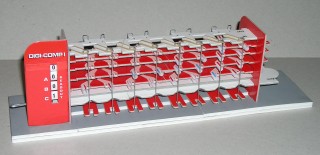 4-bit
Digi-Comps: On the Yahoo forum (Fall 2010), Kurt Kammeyer announced completion of a brassy, 2.5-pound Steampunk
version ("DIGICOMP
IV"), with 4 flip-flops and a 4-bit readout. Meanwhile,
we'd spent an evening or two hacking our own Chop
Shop Edition, derived (with some careful cutting and gluing)
from about 1.5 kit's worth of standard parts. You'll note the
sliders have migrated to the bottom, to make room for the extra
flip-flop, so we can use the same wire rods. Just an
experiment... but it works!
Now, can we come up with some interesting problems to solve in
this vastly expanded computational universe?
1000+ sold: Mid-summer 2012,
and we've passed the thousand mark. Thanks to all of our
(apparently) happy kit customers! In all this time, no shipment
has gone astray and -- aside from a few snide remarks about the
website using frames (which it still does, proudly) -- no
one's had anything but kind words for the DC1v2.0.
Shine on: As of October
2013, control rods are now being fabricated of precoated zinc
music wire (piano wire), which is sturdier/less bendy than the previous
"basic galvanized" stock and—so the fabricator
assures us—will retain its shine longer.
More Coverage: In
mid-November 2014, the tranquil pace of sales unaccountably
picked up, pushing us past the 1200 mark in sales, even
exhausting components for a week or so pending a successful (if
accelerated) 13th production run. No doubt the spike in interest
followed this
article on vintage science kits in the December issue of Discover
magazine. I have no clue how author Jim Sullivan latched onto
the DC1, but thanks for mentioning the kit. (Note: The sorry
state of the original specimen in his photo is a good argument
for investing in a nice new model!) Supply-side
heads-up: Since the kit's inception, we had been using gray
foam board (Elmer's #95204) for the base plates, selecting
unmarred individual sheets at brick & mortar suppliers like
Staples. As of December 2014, the 95204 had vanished
from stores in northern NJ. For several months we opted to ship
kits using a decent alternative (#95206, "Beige Sandstone").
Meanwhile, Staples introduced its own two-sided (bicolor) line
of foam board, but having finally found a reliable mail-order
supplier for the 95204, we'll be returning to that good old
single-sided gray in mid-April. Those of you who got Sandstone
kits can regard them as a Limited Edition of sorts. Any feedback
on color choice is welcome!
DC as a video game?
The folks at the World Video Game Hall of Fame, part of the
Strong National Museum of Play in Rochester (NY), have seen fit
to include Digi in their History of Video Games in 64
Objects (Dey Street Books, 2018). The
two-page writeup, preceded
by a full-color DPS photo of an original DC1—sadly lacking its
input/output tubes—touts the device as “a great gender
equalizer” whose “packaging featured a young boy and a young
girl, both taking part in programming the machine.” Hmm... our
kit orders over the past dozen years don’t exactly bear that
out: maybe 95% have gone out to guys. Which doesn’t alter the fact
that this is a gender-neutral toy, if ever there was one.
Where in the world...?
As we celebrate a 15th year for
the DC1v2.0, let's also celebrate the far-flung places outside the US where the kit has landed in that time. Ready?
Here we go (in order of adoption): United Kingdom, Germany, Japan,
Netherlands, Canada, South Africa, France, Spain, Finland,
Austria, Australia, Italy, Norway, New Zealand, Sweden, Abu Dhabi,
Switzerland, Israel, Mexico, Portugal, Croatia, Brazil, South
Korea, Poland, Czech Republic, Faroe Islands, Russia, Ireland,
Denmark, Thailand, Luxembourg, and most recently (Dec 2019) two
kits to Taiwan.
Pause for the Cause: We are sixteen, going on
seventeen... and concentrating more these days on fleshing out the still-offline version of this site, as
originally conceived. Time for Digi-Comp to take a back seat and amuse itself quietly with a Nintendo
Switch (or better yet, just stare out the window) while we put pedal to the metal. Hopefully the kit will
be back in production by June of 2022. Email me to convey your pent-up demand!
Hiatus terminus: As of July 2022, we are back in
production with another batch of die-cut boards, our first since pre-covid days. We've used the same
suppliers for over 15 years, and fortunately they're all still afloat, but the paper industry in general
has been hard hit. We had to go with lighter (135 gsm), "glossy" stock as opposed to the slightly denser
(170 gsm) "ultra glossy" paper of past kits. Results were fine, but our printer was busier than expected
because so many of his competitors have shut down. Then the die-cutter erred in trimming down large sheets
of binder's board to the 9x12s supplied in the kit. Only after the first die-cutting run did we realize
the grain of the finished boards was running the wrong way, weakening the longer pieces. Back to Square
One, with another printing run, and the die-cutter making good on the error. Thanks for your patience during the interval. Good to be back.
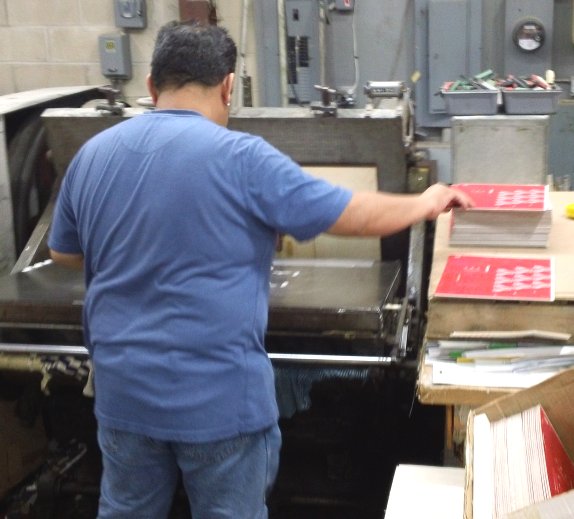 Hot off the press:
This time around (June, 2024), a flawless fabrication cycle, and another batch of a hundred or so. Here's
the final stage, as César grabs the top board from a stack of printed/mounted sheets, and prepares to run
it through the diecut press. Meanwhile, I'm inspecting the output and filling the foreground box with
ready-to-ship sheets. Proprietor Vic tells me the original die blades are losing sharpness (we know the
feeling), and it could be time for re-knifing. Fortunately, César is a master of the make-ready, an intermediate sheet of paper
and tape that locally fine-tunes the machine's pressure, and has been getting it right for nearly 20 years.
|